Retail cold display cases are unique engineering creatures. Unlike a standard industrial cold room, which is an insulated box designed strictly for static storage, a display case must constantly invite customer hands inside while simultaneously keeping food chilled to precise tolerances. They are exposed to supermarket drafts, fluctuating ceiling ambient conditions, customer traffic, and daily product restocking.
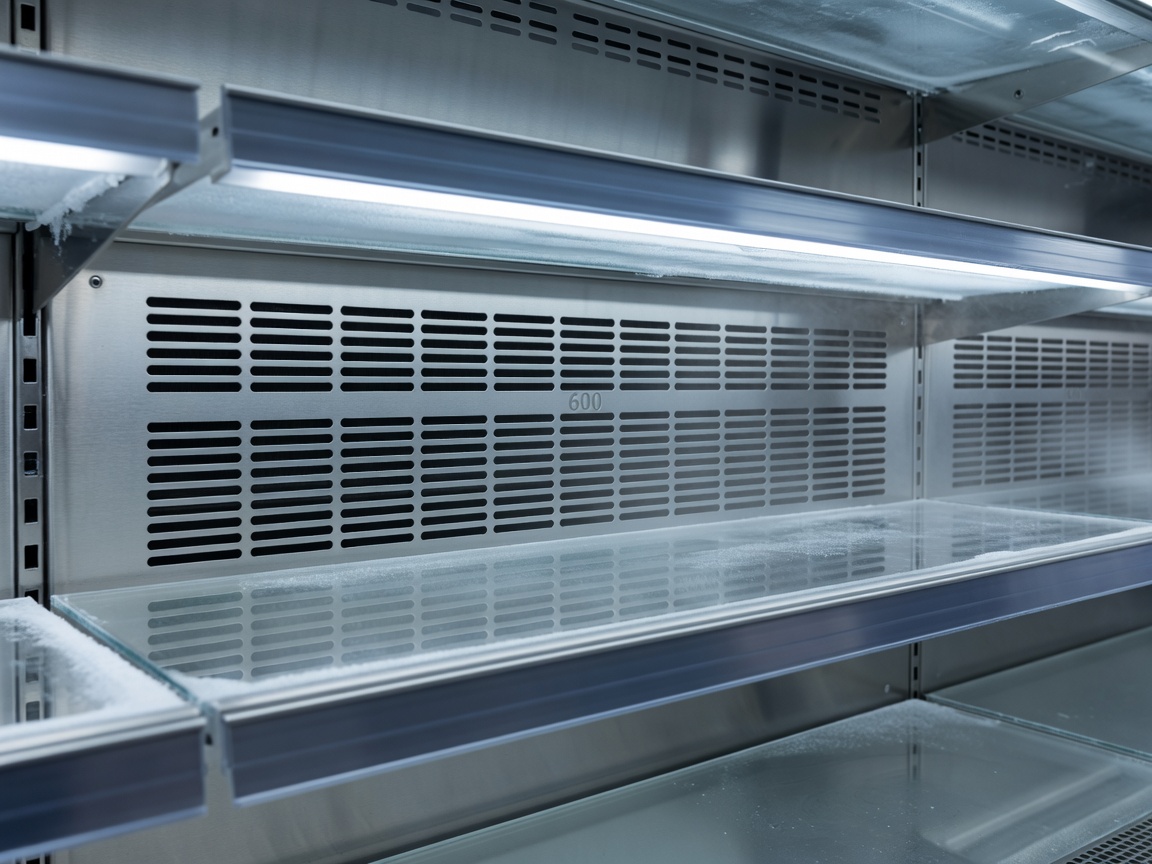
Open Multi-Deck Chillers vs. Glass-Door Cabinets
In modern European supermarkets, there has been a steady migration from fully open multi-deck cases to glass-door retrofits. However, both formats present specific servicing challenges:
Open Cases & The Air Curtain Challenge
An open case relies completely on a hydrodynamic boundary layer—the air curtain. Air is drawn into the bottom return grille, pulled across the evaporator coil by low-profile fan trays, pumped up the insulated back plenum, and ejected downward from a honeycomb discharge nozzle at the top. If the honeycomb gets clogged with dust or store flyers, or if the return grille is obstructed by misaligned wire baskets, that air curtain detaches. The result? Warm store air enters unimpeded, frost clogs the coil within hours, and dairy or pre-packed meats at the front of the shelf warm up.
Glass-Door Freezers & Thermal Gaskets
Glass-door freezer cases eliminate the air curtain problem but introduce physical mechanical fatigue. A busy supermarket door opens hundreds of times each day. The hinges must self-close reliably, torsion springs must remain tensioned, and anti-sweat glass heaters must balance thermal conduction to prevent glass condensation without cooking the ice cream behind it. A failing perimeter gasket causes continuous icing along shelf edges and frozen lockups on shelf slides.
Drainage Pan Biology: The Condensate Battleground
Perhaps the most unglamorous yet operationally perilous aspect of display case maintenance is condensate drainage. During every scheduled defrost cycle, melted coil frost cascades down into a shallow stainless or galvanized basin under the bottom deck. In dairy and meat cases, stray milk leaks or meat juices inevitably wash into this basin.
Without regular chemical sanitization, bacterial biofilm (frequently nicknamed "refrigeration slime") forms thick gelatinous plugs that block the 32mm drain pipe. Water backs up, overflows into the customer aisle, and seeps beneath adjacent fixtures. Routine preventive service requires physical removal of deck plates, vacuuming the basin, clearing drain P-traps, and placing time-release enzymatic biocides.
| Display Asset Type | Core Temperature Range | Primary Failure Vulnerability | Key Preventative Routine |
|---|---|---|---|
| Open Multi-Deck Dairy | +1°C to +4°C | Air curtain detachment from overstocking; blocked honeycomb | Honeycomb wash; velocity anemometer verification; load line audits |
| Glass-Door Reach-In Freezer | -18°C to -22°C | Gasket split; door hinge droop; anti-sweat heater failure | Thermal imaging of frame; dollar-bill seal friction test; hinge realignment |
| Serve-Over Deli Counter | 0°C to +2°C | Direct product air drying; meat juice drain coagulation | Gravity coil wash; gentle airflow velocity tuning; deep pan sanitization |
Practical Field Inspection Checklist for Display Cases
Monthly Display Case Servicing Walk
- Lift lower deck pans and inspect drain well for standing water or stagnant residue.
- Test EC fan assemblies for bearing hum, axial play, and free rotation.
- Inspect honeycomb discharge grilles for dust accumulation or bent plastic cells.
- Verify glass-door self-closing mechanism from a 30-degree opening angle.
- Inspect electrical conduit feeding under-shelf LED lighting for moisture ingress.
- Check digital controller probe calibration against a calibrated needle thermometer.
Operational Limitations & Best Practices
Technicians can optimize air velocity and coil superheat perfectly, but if store floor operations continually stack yogurt cartons 50mm past the load boundary limit, the case will fail. Retail refrigeration maintenance is fundamentally an operational partnership between technical service engineers and in-store supermarket staff.
Maintenance Guidance: Avoid using aggressive solvent cleaners on acrylic risers or polycarbonate door frames, which can induce micro-crazing and clouding over time.