A mid-sized supermarket is essentially an industrial refrigeration plant masquerading as a grocery store. Behind acoustic partition walls and rooftop parapets, central compressor racks circulate hundreds of kilograms of refrigerant through extensive copper and stainless steel distribution manifolds, serving dozens of refrigerated cases, walk-in meat prep rooms, and bulk holding freezers.
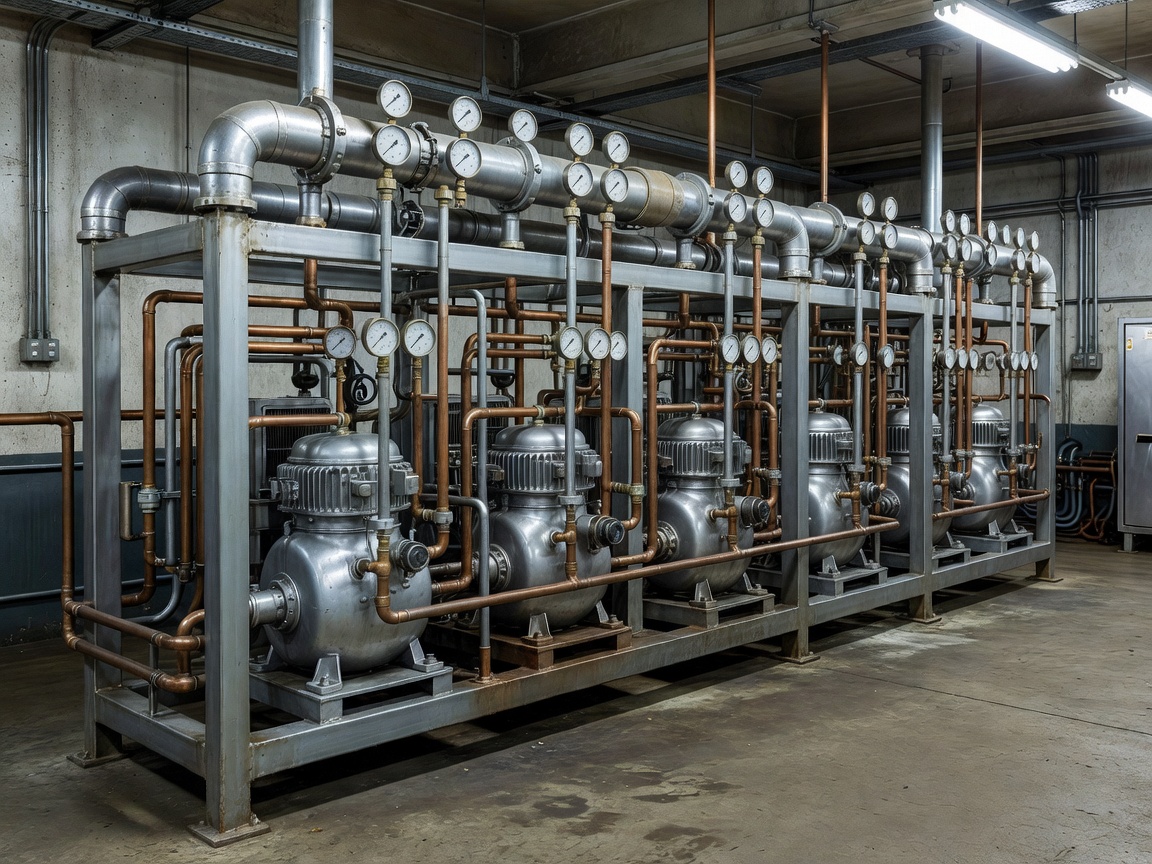
Centralized Racks vs. Distributed Pack Architectures
Historically, supermarkets relied entirely on centralized direct-expansion (DX) systems located in a single remote plant room. While centralized racks offer single-point maintenance convenience, they demand extensive suction and liquid piping networks underneath the sales floor, creating numerous joint points vulnerable to vibration wear and potential leakage.
Modern store layouts increasingly balance centralized architecture with distributed sub-packs or secondary loops (such as pumped cold brine or liquid CO₂). Understanding your specific plant topography is foundational to any maintenance regimen. In a transcritical CO₂ setup, for example, gas cooler pressures routinely exceed 85 bar on hot summer afternoons, requiring rigorous safety relief valve inspection and high-pressure controller testing that simply do not exist in conventional HFC systems.
Back-of-House Walk-in Cold Rooms
While the sales floor attracts store management attention, back-of-house cold rooms represent major thermal inertia assets. These rooms endure punishing fork-truck and pallet-jack loading traffic. Strip curtains get torn down, heavy insulated sliding doors are frequently left propped open during delivery shifts, and wall panels suffer forklift impact.
Our service protocols focus heavily on room envelope integrity: checking threshold heater wire continuity (preventing door bottom gaskets from freezing fast to the floor), inspecting ceiling evaporator hanger rods for structural deflection, and clearing ceiling-mounted drain lines.
Store Operating Hours and Service Planning Coordination
One cannot simply shut down a suction group on a Saturday morning while hundreds of customers are shopping. Doing so would trip cases into alarm, risk product core temperatures, and create store-wide confusion. Effective supermarket cooling servicing requires strict operational coordination:
Major intervention work—such as replacing compressor valve plates, evacuating a circuit to renew moisture indicator cores, or acid-testing compressor oil—is scheduled during overnight restocking windows or early morning off-peak periods. Case suction isolation valves allow technicians to service an individual meat display circuit while the remainder of the medium-temperature rack continues uninterrupted.
| Plant Configuration | Primary Advantage | Maintenance Complexity | Service Priority Points |
|---|---|---|---|
| Central Direct Expansion (DX) | High thermal capacity from single mechanical room | Moderate to High; long subterranean piping routes | Vibration damping, oil return loops, underground trench inspections |
| Transcritical CO₂ Booster | Eco-friendly natural refrigerant, high heat recovery | High; elevated operating pressures up to 120 bar | High-pressure valves, gas cooler cleanliness, oil return management |
| Secondary Glycol Loop | Minimal primary refrigerant charge; zero leak risk on sales floor | Moderate; secondary pump balancing required | Pump mechanical seals, glycol concentration & pH inhibitors, heat exchangers |
Practical Supermarket Plant Checklist
Quarterly Central System Checkpoints
- Inspect oil level regulators and float assemblies across all rack compressors.
- Test acoustic vibration isolators on suction and discharge headers for fatigue cracks.
- Verify rooftop condenser / gas-cooler fan speed stepping and inverter drive cooling fans.
- Calibrate transducer readings against mechanical test gauges across low and high stages.
- Inspect cold room pressure relief ports to ensure free movement without ice binding.
- Conduct sniffer electronic leak detection across plant room flanged connections and valves.
Navigating Operational Limitations
Modern automated store controls are remarkably sophisticated, yet they can mask underlying mechanical degradation. For instance, variable-speed inverter drives can compensate for declining compressor efficiency by ramping up motor RPM, hiding mechanical wear until sudden catastrophic failure. Periodic physical teardowns and vibration analysis remain irreplaceable.
Operational Note: Regulatory standards regarding maximum allowable refrigerant leakage rates (such as EU F-Gas or UK equivalents) mandate precise log keeping. Ensure your logbooks are updated after every rack service.